


Surgical Guides & Guided Surgery
At Oralzone, surgical guides are designed with the final restoration as the starting point. Whether the case calls for a pilot guide or a fully guided protocol using CBCT-based planning, the objective is the same: give the clinician the spatial information needed to place the implant where the prosthetic outcome requires it.
Two Types of Surgical Guides
Guided Surgery (Pilot Guide)
Designed from a digital waxup and model, this guide provides pilot hole positions as a directional reference for implant placement, no CBCT required. Less constraining than a fully guided protocol, but significantly more predictable than freehand. Can also serve as a radiological guide in eligible cases.
Fully Guided Surgery (CBCT-Based)
Implant positions are planned in dedicated software using a digital impression and CBCT DICOM file, prosthetically driven, the crown position determines where the implant goes. The clinician reviews and approves the full planification through a portal before any guide is printed. Indicated for complex cases, limited bone volume, and immediate loading scenarios.
/MATERIALS
Both guide types are produced using biocompatible 3D-printed surgical guide resin, fabricated in-house on our printing equipment. All guides are designed digitally before printing, allowing for review and modification prior to production.
Fabrication Workflow
Pilot Guide
A digital waxup is created in CAD software based on the model and the planned restoration. Pilot hole positions are integrated into the guide design according to the prosthetic plan. The guide is then 3D printed in-house following clinician validation of the design.
Fully Guided
Implant positions are planned using dedicated implant planning software, integrating the CBCT DICOM data and the digital impression. Once the planification is complete, the clinician is notified and accesses the case through a review portal to verify angulation, depth, and position of each implant. The surgical guide is only printed after explicit clinician approval of the plan.
Impression & Scan Requirements
Pilot Guide
- Digital scan or conventional impression (analog accepted)
- Model and waxup indicating the planned restoration
Fully Guided
- Digital scan or conventional impression
- CBCT DICOM file of the surgical site
- Implant system information (platform, diameter, length preferences if applicable)
Why Surgical Guides Improve Case Outcomes
The implant position is set by the restoration, not adjusted around it.
Prosthetically driven placement means the crown, emergence profile, and abutment design are all considered before the osteotomy is made. This eliminates the compensations, angled abutments, suboptimal emergence contours, compromised aesthetics, that result from freehand placement that did not account for the prosthetic requirements.
Clinician validation before fabrication.
For fully guided cases, the planification is reviewed and approved through a portal before any guide is produced. The clinician signs off on every implant position. There are no surprises at surgery.
Reduced technique sensitivity versus freehand placement.
Freehand implant placement can yield excellent results in experienced hands, but it is inherently technique-sensitive and dependent on intraoperative judgment. A surgical guide removes the positional variables, which increases consistency across cases and reduces the margin for error regardless of surgical conditions.
Dual-use option for pilot guides.
In eligible cases, the pilot guide can serve as a radiological guide, providing an additional layer of planning information without additional fabrication cost or workflow complexity.
In-house design and printing.
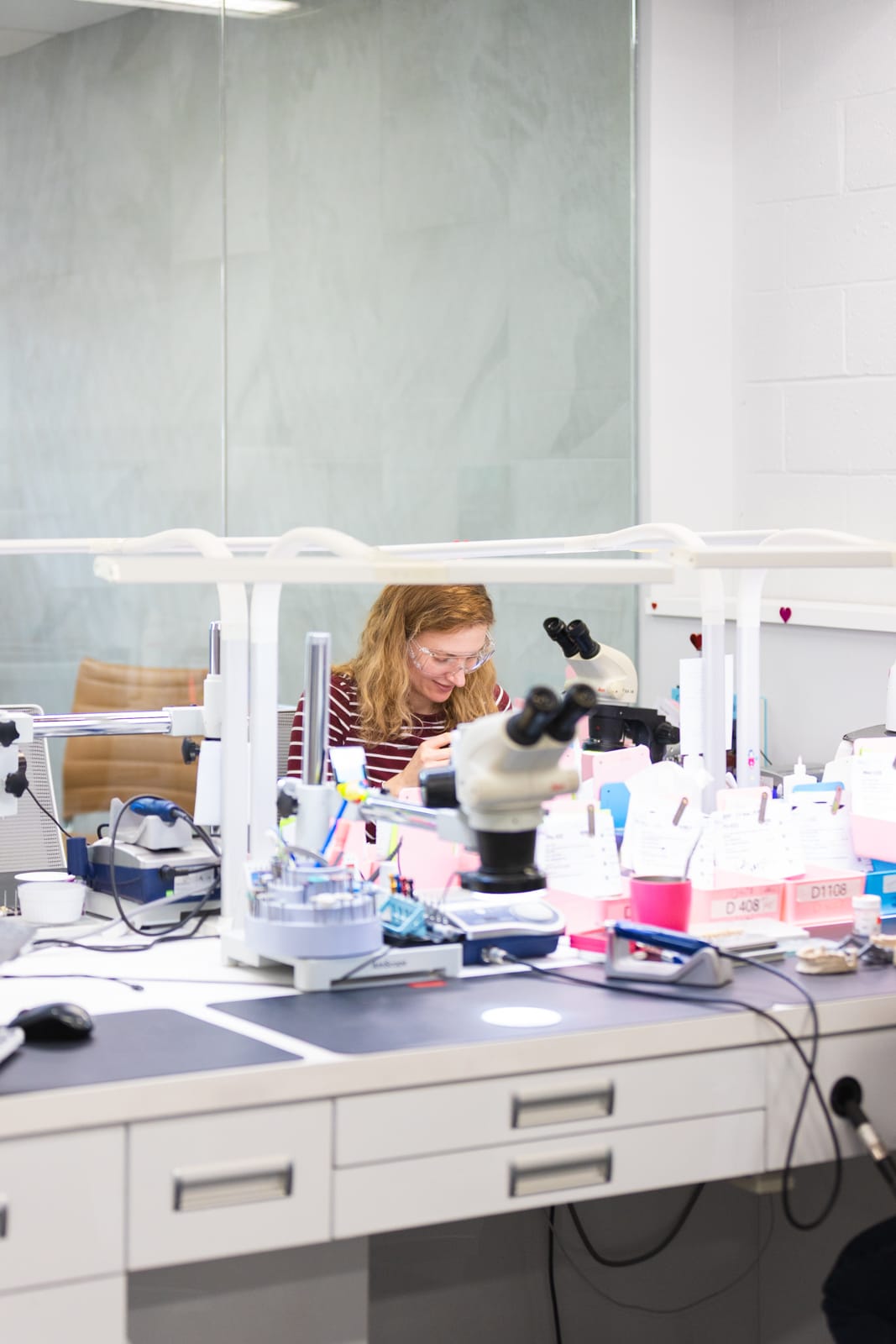
All guides are designed and printed at our Montreal facility. Turnaround is not dependent on a third-party printing center, and any modification requests can be addressed directly with our team.