


Crowns & Bridges on Implants
The success of an implant restoration is not determined at placement, it is determined by the precision of the prosthetic component and the quality of communication between the restoring clinician and the laboratory.
At Oralzone, implant cases are treated as collaborative clinical projects. We manufacture custom abutments and restorations entirely in-house, using a workflow built around fit accuracy, emergence profile, and long-term implant health.
/MATERIALS
Custom Abutments
The majority of our implant restorations use custom-milled abutments rather than stock titanium bases. This is not a preference, it is a clinical decision. Stock Ti-bases frequently produce suboptimal emergence profiles and increase the risk of decementation over time. A custom abutment is designed to the exact geometry of the implant position and the soft tissue architecture, which produces a more stable cement seal, a correct emergence profile, and reduced long-term bone resorption risk.
Custom abutments are available in zirconia and titanium depending on the indication, aesthetic zone, and clinician preference.
/01 Zirconia
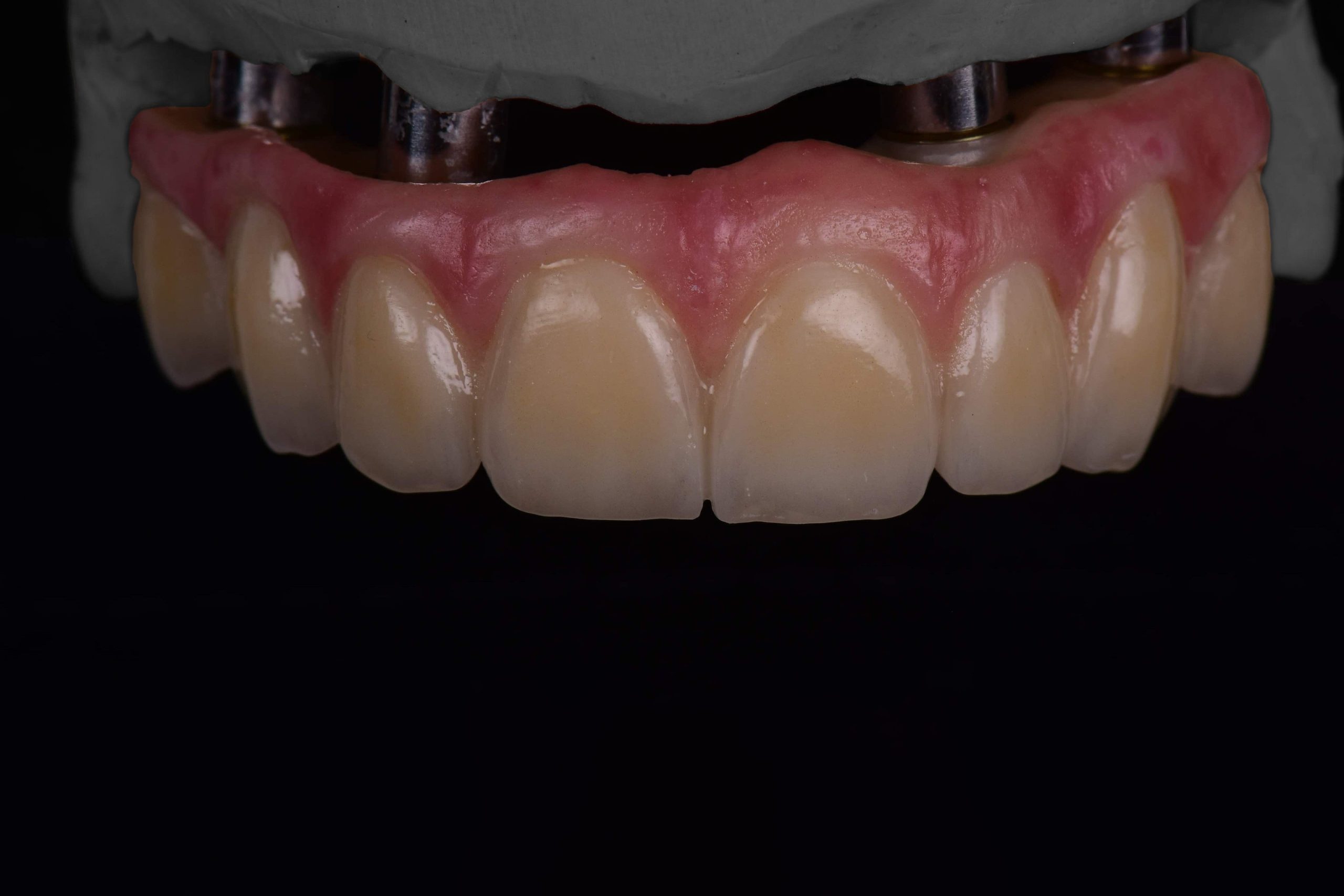
Our primary material for single-unit restorations. Unlike most labs that use a monolithic zirconia with a single translucency gradient (typically 4Y), Oralzone uses a proprietary tri-layer zirconia combining three distinct translucency zones, 3Y, 4Y, and 5Y, in a single block. This creates a natural depth of color, strength contrast, and esthetic result that standard monolithic zirconia cannot replicate.
- Flexural strength: up to 1,200 MPa
- Optimal for single-unit crowns, implant-supported crowns, and most anterior and posterior cases
- Compatible with full-contour and cutback techniques
- Not recommended for short vertical height bridges or multi-pontic spans where flexural load could cause fracture
/02 Emax
Our preferred material for onlays, veneers, and cases with conservative preparations where bonding surface is a priority.
- Flexural strength: ~500 MPa
- Superior bonding characteristics to the preparation compared to zirconia
- Ideal for minimally invasive cases, thin preparations, and cases requiring maximum light transmission
- Not indicated for bridges, bruxers, or cases under heavy occlusal load
/03 Metal-Ceramic
Indicated when structural reliability takes precedence over monolithic zirconia, specifically for bridges with limited vertical height, long-span pontics, or multi-unit cases where zirconia’s brittleness becomes a clinical risk.
- Provides a metal substructure that absorbs and distributes occlusal forces more effectively in demanding geometries
- Available for single-unit crowns at clinician request
- Reliable in posterior full-arch cases and complex bridge configurations
Fabrication Workflow
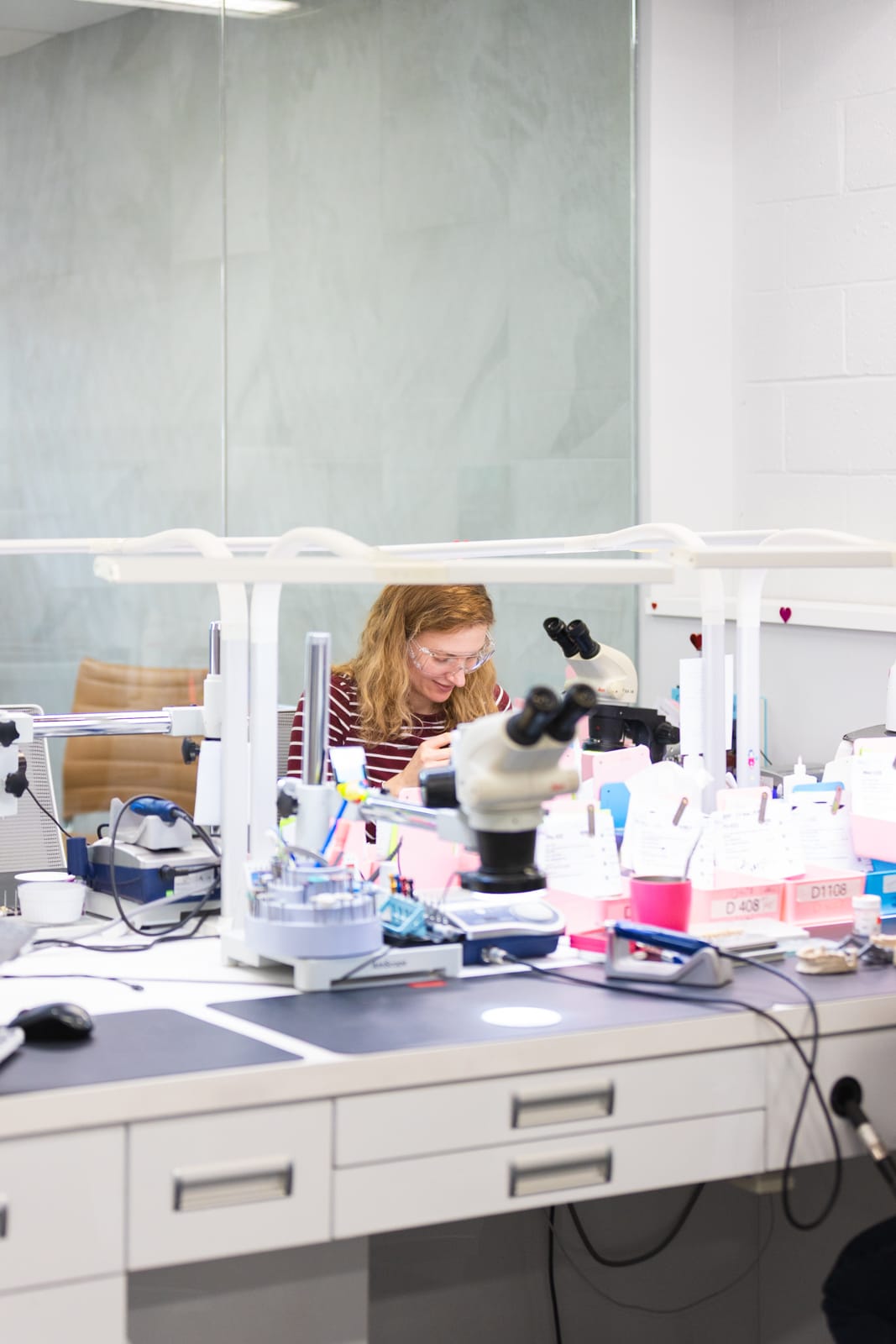
Every implant restoration, from abutment design to crown finishing, is completed in-house at our Montreal facility. No third-party milling centers. No outsourcing.
Each case is handled by a dedicated technician who manages the full sequence: implant analog mounting, custom abutment design in CAD, milling, crown fabrication, and final verification of fit and emergence profile. This continuity ensures that the abutment and the crown are designed as a unified system, not as two separate components assembled after the fact.
We work with all major implant platforms and can confirm compatibility before fabrication begins.
Impression & Scan Requirements
Oralzone accepts both digital implant scans and conventional implant-level impressions. Compatible platforms include 3Shape Trios, iTero, CEREC, Medit, Carestream, Shining 3D, and others. Scan body compatibility is confirmed on a case-by-case basis, contact the lab before submitting if you have questions about a specific implant system.
For implant cases, pre-case consultation is not optional, it is the process. The position of the implant, the available vertical restorative space, the soft tissue profile, and the occlusal scheme all determine which abutment solution and which material are appropriate. A 10-minute protocol discussion before the impression appointment eliminates the majority of issues that generate remakes, retakes, and extended chair time.
For straightforward single-unit implant cases, a digital prescription through our online portal is sufficient, provided the implant system and scan body are clearly identified.
Why Work with Oralzone for
Your Implant Cases
Custom abutments milled in-house. We do not rely on stock Ti-bases as a default. Every case is evaluated for whether a custom abutment is indicated, and when it is, we design and mill it at our facility to the exact parameters of the implant position and soft tissue architecture.
Correct emergence profile, by design. Improper emergence profiles are one of the leading causes of peri-implant bone resorption and long-term implant complications. Our custom abutment workflow is engineered specifically to respect natural emergence contours and support soft tissue health.
Reduced decementation risk. Crown decementation on implant restorations is frequently a function of a poor cement seal geometry, not cement selection. A properly designed custom abutment produces a retention form that significantly reduces this risk over the long term.
Zero outsourcing. Abutment design, milling, and crown fabrication are all performed at our Montreal lab. You have one point of contact for the full restoration, and full traceability on every component.
Platform-agnostic workflow. We work with all major implant systems. If your case involves a less common platform, contact us before the impression appointment and we will confirm compatibility and scan body requirements.
Door-to-door pickup and delivery. Your cases are picked up and returned to your clinic by our in-house delivery team, no couriers, no delays, no chain-of-custody concerns with precision components.